


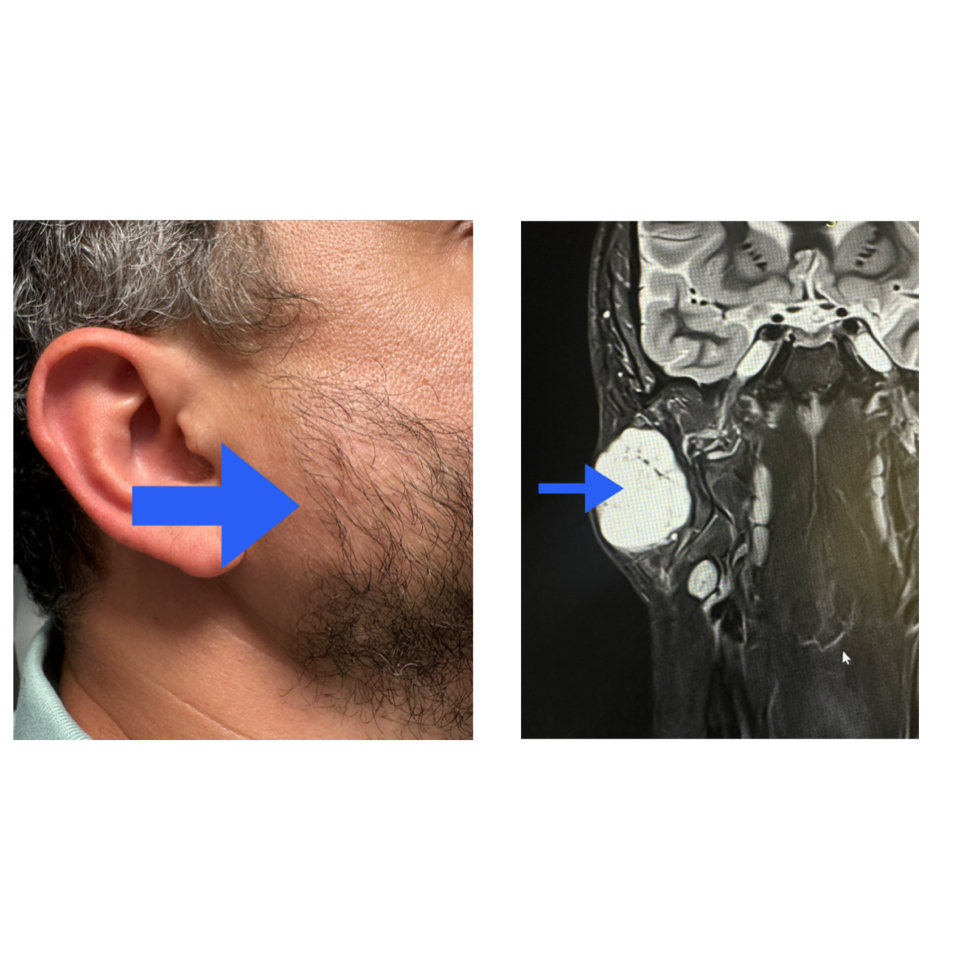
Approximately 80% of parotid tumors are benign. The most common is pleomorphic adenoma, followed by Warthin tumor as the second most common benign tumor.
The most feared complication of parotid surgery is facial nerve paralysis. Because of this risk, some patients may be reluctant to undergo surgery and choose to postpone it. However, delaying surgery can have disadvantages.
It should be remembered that there are nearly 40 different types of parotid tumors. The definitive diagnosis of a parotid tumor can only be established after the tumor has been removed and the surgical specimen has undergone histopathological examination. Preoperative imaging findings, particularly MRI findings, together with fine-needle aspiration biopsy (FNAB), can provide a preliminary diagnosis. However, this preliminary diagnosis is not always accurate. Therefore, a tumor thought to be benign may ultimately prove to be malignant (cancer) on final pathological examination.
Another important consideration is the possibility of malignant transformation of pleomorphic adenoma. If a pleomorphic adenoma is left untreated for more than 10 years, there is a certain risk that it may undergo malignant transformation. For this reason, prolonged postponement of surgery is generally not recommended in patients with a preliminary diagnosis of pleomorphic adenoma.
On the other hand, if a parotid tumor is clinically and radiologically consistent with a Warthin tumor, and two independent fine-needle aspiration biopsy results support the diagnosis of Warthin tumor, observation without surgery may be considered in patients who are reluctant to undergo surgery, particularly in elderly patients and those with significant risk factors. Malignant transformation of Warthin tumors has not been reported in the literature.
Another disadvantage of delaying surgery for a long period is that as the tumor grows, the extent of surgery may need to be increased. The accompanying image shows an MRI scan of a parotid tumor that had been present for approximately 25 years.
As the tumor grows, the risk of facial paralysis does not decrease. On the contrary, as the surgical field becomes more extensive, a larger portion or even the entire facial nerve may be placed at risk.
In conclusion, particularly in patients with a preliminary diagnosis of pleomorphic adenoma, prolonged postponement of surgery is not recommended. If the initial evaluation raises suspicion of cancer, the most appropriate approach is to proceed with surgery as soon as possible.